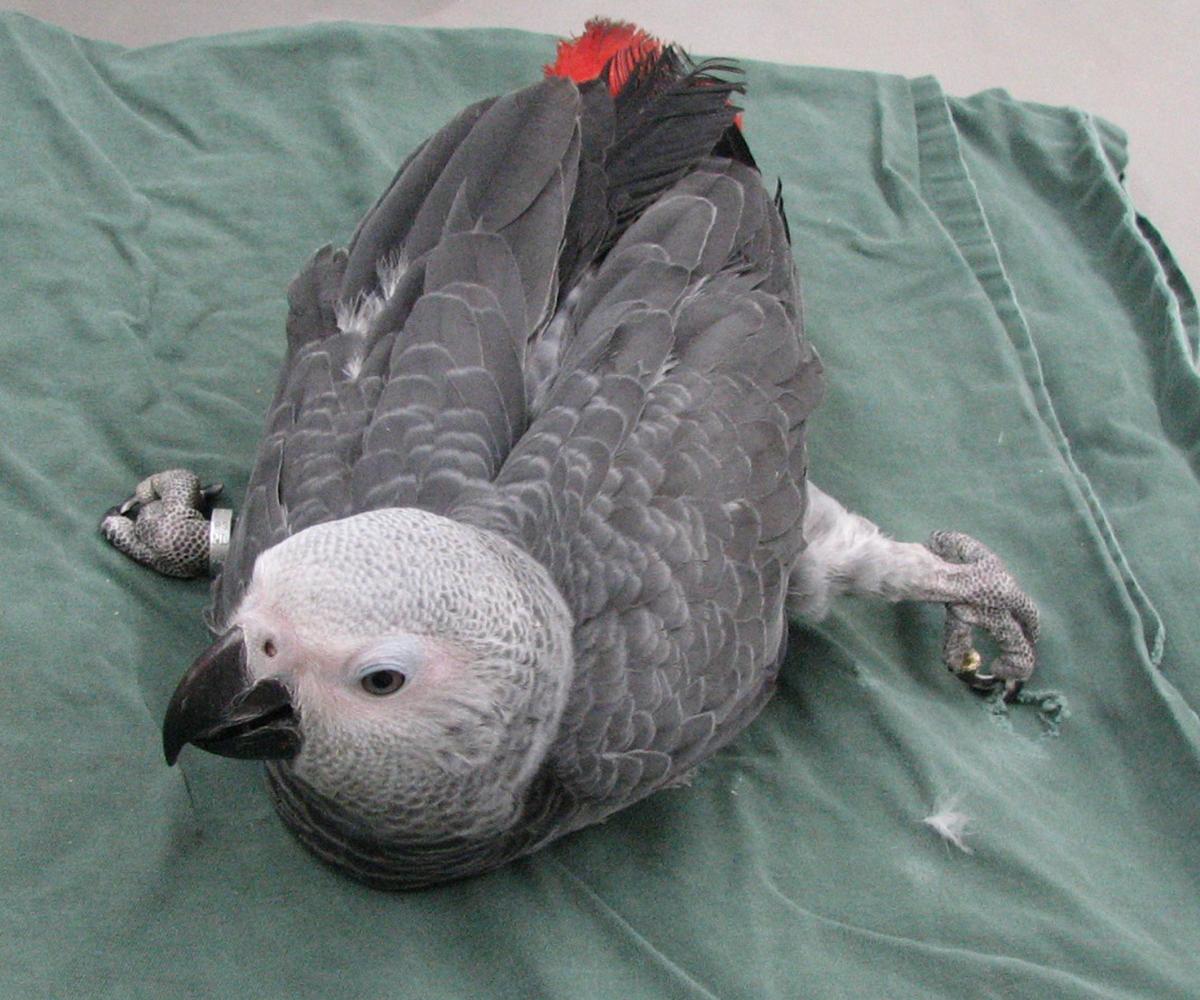
Calcium deficiencies in African Grey parrots have been recognized in avian medicine for many years. With Calcium deficiencies during the development of a young parrot we see skeletal abnormalities known as Rickets or English disease. In older African Grey we mainly see metabolic disorders that are accompanied by abnormalities that resemble epilepsy symptoms in humans, with or without convulsions.
.jpg)
Research has shown that a large percentage of captive-born African Grey have skeletal abnormalities to a greater or lesser extent. The abnormalities are often clearly visible or palpable. In other cases, an X-ray is needed to demonstrate the abnormalities.
It is also no exception that sometimes major operations have to be carried out to enable the birds to use 1 or 2 legs. This is a remarkable difference with, for example, Amazons, where Rickets is a very exceptional condition. It is clear that the metabolism of Amazons is different from that of African Grey.
There are strong indications that African Grey have a greater need for sunlight to support Vitamin D3 metabolism.
The best-known causes of calcium deficiencies in African Grey are metabolic disorders due to nutritional errors and a lack of sunlight.
To prevent these metabolic problems and as part of the treatment of Rickets, High Potency Coarse from Harrison's Bird Foods is recommended as the food for African Grey. It is striking that skeletal quality appears to improve remarkably within a few days after a feed switch. High Potency Coarse is also recommended for birds with egg laying problems and wind eggs. It is striking that often within 2-3 days the bird is able to make a good egg shell. The advice to give High Potency Coarse to African Grey is endorsed by many bird veterinarians and bird specialists worldwide.
Dr. Michael Stanford has conducted scientific research for several years with a group of 100 African Grey on, among other things, calcium metabolism and the importance of vitamin D3.
One of the results of the research is that there are misunderstandings when it comes to blood determinations of Calcium. The standard method, as generally used in laboratories to determine the amount of Calcium in the blood, generally does not provide a reliable reflection of a possible Calcium deficiency. The best method is to determine the circulating 'ionized calcium'.
As part of his research, Gray Redstarts were fed Harrison's High Potency Coarse. It turned out that no indications of metabolic problems based on calcium deficiencies or other deficiencies were found in these African Grey. Based on his research, Dr. Stanford advised to give High Potency Coarse to African Grey.
Dr. Michael Stanford has done groundbreaking scientific work on this point and is considered one of the leading authorities on this point. Dr. Standford has also been awarded by the British Veterinary Association.
Click here: “CALCIUM METABOLISM IN GRAY PARROTS” to view the publication of Dr.'s research. Stanford to download.
Click here for a summary of the research/publication in Avian Examiner: Avian Examiner – Calcium Metabolism – Michael Standford – 2003 HBD International.
The Bird Clinic has advised since 1989 to give High Potency Coarse to African Grey, both African Grey that are kept as pet birds and African Grey that are kept as breeding birds.
To date, the Clinic for Birds has not identified any examples of calcium deficiencies in African Grey that eat HPC. It is and remains important that birds can also benefit from sunlight because UV light plays an essential role in Vitamin D3 metabolism.
It is not recommended to give African Grey additional Calcium in the form of powder or via drinking water. In combination with High Potency Coarse, there is no indication that this is necessary. At the same time, due to uncontrolled additions, there is a serious risk of overdoses of Calcium. Overdoses of Calcium can ultimately cause similar complaints as with nutritional deficiencies. Providing good and complete nutrition is essential. We must bear in mind that nutritional errors should never actually be compensated by adding a single ingredient. The so-called extras rarely improve the overall nutritional story. If a dog receives a good, complete diet, no expert will say to give some extra calcium, vitamins, etc.
Of course, we can give parrots a wide variety of treats and treats in addition to pellets from Harrison's Bird Foods. However, we should not think that we can improve a parrot's diet with a piece of apple.
See also the video with examples of parrots with rickets and the treatment of a Timney with serious problems below.
Copyright © Advisory Practice for Birds | drs. Jan Hooimeijer. No part of this publication may be reproduced or copied without written permission from Jan Hooimeijer. Sharing the article in its original form is of course permitted (and even desirable) on the condition that this is always done with clear source information. The article has been compiled with the utmost care. However, the author cannot accept responsibility for any damage of any kind resulting from defects in the content.