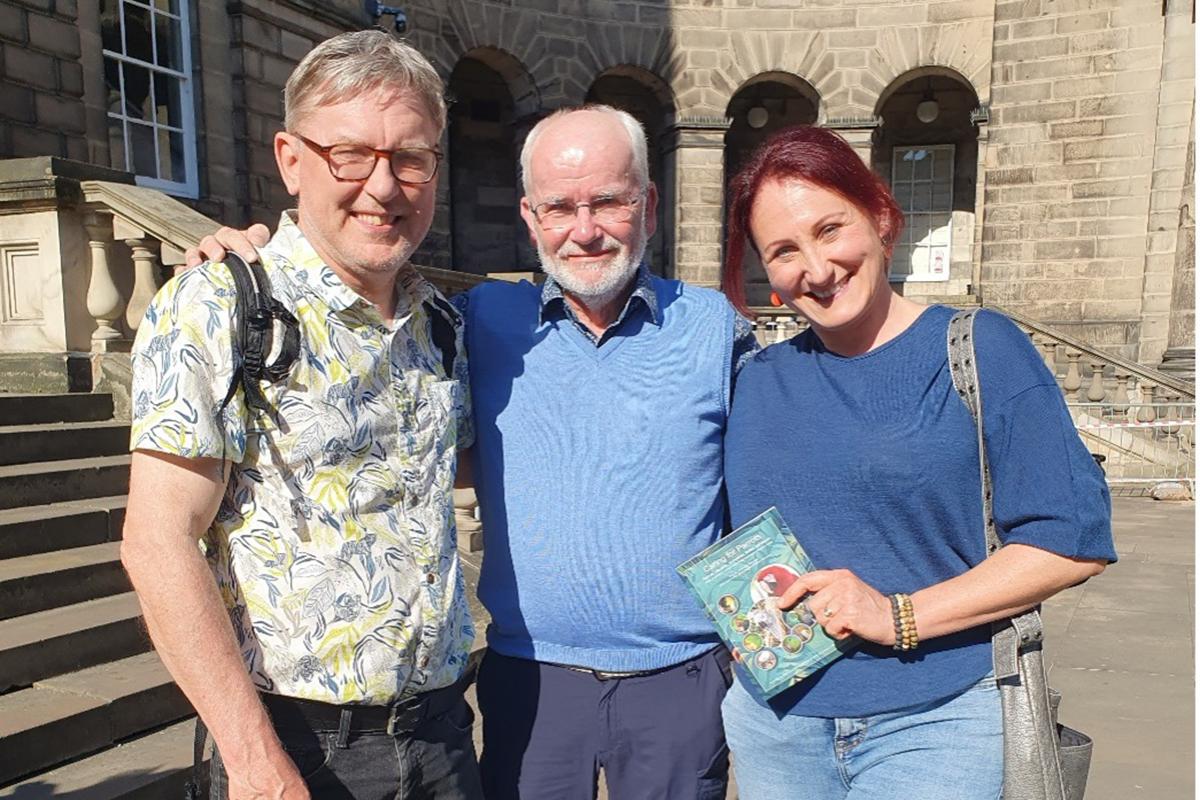
In het weekend van 10 mei 2025 was ik in Edinburgh om daar een seminar te presenteren aan studenten diergeneeskunde en collega’s van The University of Edinburgh, The royal (Dick) School of Veterinary Studies.
Hieronder de review van collega Sheryl Calway als deelnemer aan het seminar in Edingburgh:
"I’ve been a vet since 2001 and work solely with exotic animals including birds. Despite being experienced in my job, Jan has completely opened my eyes to a whole new way of thinking, which has been a game-changer both in my clinic and at home.
Jan’s teachings and their ethological basis make total sense and it soon becomes clear during his seminars that so many of the problems we encounter as humans are caused through society being organised in a fundamentally flawed way. With this knowledge, it is hardly surprising to realise that we are raising our children in ways that can only set us (and them) up for failure. Parrots have evolved over millions of years and studies demonstrate their advanced levels of intelligence and cognition, on a par with young children. It therefore seems logical to acknowledge that we are doing our parrots (and our children) an injustice through our lack of understanding and provision of positive role-models.
Jan’s lectures and accompanying books put this into context but also guide us practically through the 5-step Behaviour Protocol. I can’t pretend this is easy!
The principles make complete sense but it requires a significant degree of re-wiring of our thoughts and words to get it right. However, our parrots (and children) are great teachers and we owe it to them to put the work in - to understand what constitutes normal behaviour and how to encourage desired behaviour.
At the same time, eliminating enforced and undesired behaviours will make our relationships so much more meaningful and mutually satisfying, whether these are human-to-human or human-to-bird relationships.
Since it has been human choice to force parrots to live as undomesticated animals in captivity, and it is our actions that lead to vast numbers of them being surrendered to shelters, it must now be our responsibility to make the necessary changes.
As parrot owners and especially as (avian) veterinarians we need to acknowledge, as Jan says, “If not us, who? If not now, when?”.
Thank you Jan, for your tireless efforts to improve the lives of the animals (and other humans) we are lucky to share our planet with!
- Sheryl Calway BVMS MRCVS PgC(EAS) -
RCVS Advanced Practitioner in Zoological Medicine.
Na afloop van het seminar in 2019 kreeg ik de volgende reactie van Prof. Andrew Gardiner:
“The seminar was fascinating in terms of giving an insight into the behaviour and welfare of parrots, and a great deal of what was covered relates to other species as well. There is a strong argument for increasing the behaviour content of veterinary curricula. Events like this help make the point. For me, the biggest take-home message was the use of displacement behavior as distraction technique to deflect the attention of 'misbehaving' parrots (or children - the analogy was well made in one of the talks!). The reasoning behind this was presented in a clearer way than I have heard before. The workshop served to debunk many common misconceptions.”
The comments by the Veterinary Students Behaviour Committee that organised the seminar:
“In the modern context of increased understanding of the abilities and behavioural needs of our avian patients, we have no excuse but to be doing our utmost to focus on positive welfare-based interactions and husbandry. The outcome of the research Dr. Pepperberg's is instrumental and emphasize that we need to acknowledge the intelligence and cognition of parrots to ensure their welfare in captivity.
Animal behaviour is extremely important in veterinary medicine. We believe that cooperative care and animal choice is integral for good animal welfare. Drs. Jan Hooimeijer presented about low-stress handling techniques, creating mutual respect and mutual trust. We think that more attention should be paid to these topics, within the veterinary curriculum.
Drs. Jan Hooimeijer’s presented about appropriate management of the local environment and made clear that there is a significant lack of basic husbandry knowledge amongst veterinarians and parrot owners. Husbandry training is the future for reducing stress, reducing healthproblems, improving welfare and improving safety.
Therefore, we feel that much greater emphasis should be placed upon pre-purchase consultation to ensure the welfare and health of parrots, within the veterinary curriculum. Psittacines are incredibly complex birds with amazing mental capacities, it is impossible to tend to their needs appropriately without understanding their species-specific perspectives and cognitive contexts.
We believe that this should be greater emphasised within the veterinary curriculum. In order to achieve the best standard of care possible, we believe that the veterinarians of the future must be able to take into consideration the cognitive capacities and natural ethological characteristics of each species they aim to treat.”
Copyright © Adviespraktijk voor Vogels | drs. Jan Hooimeijer. Niets van deze uitgave mag worden vermenigvuldigd of gekopieerd zonder schriftelijke toestemming van drs. Jan Hooimeijer. Het artikel in originele vorm delen is uiteraard wel toegestaan (en zelfs gewenst) onder de voorwaarde dat dit altijd met duidelijke bronvermelding gedaan wordt. Het artikel is met de grootste zorg samengesteld. Nochtans kan de auteur geen verantwoordelijkheid aanvaarden voor enige schade van welke aard dan ook voortkomende uit gebreken in de inhoud.